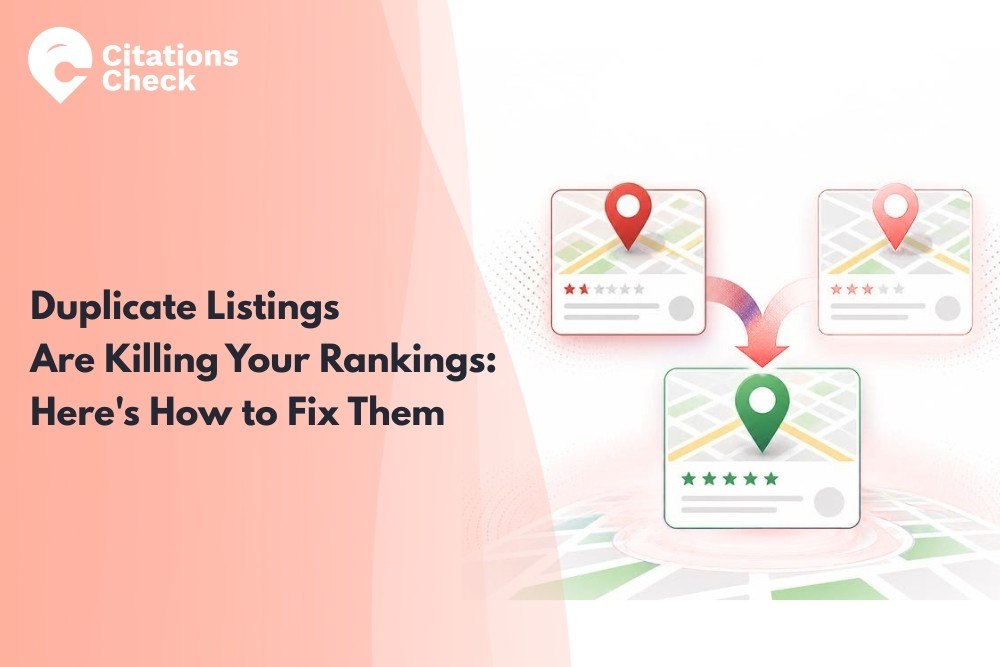
Quick Summary: How do duplicate listings hurt your local search rankings?
Duplicate listings split your review volume, scramble your Name, Address, and Phone (NAP) signals, and confuse local search algorithms. When search engines encounter conflicting records for one physical storefront, they lose confidence in your primary profile, suppress your map pack rankings, and redirect prospective customers to clearer local competitors.
Running a local shop or service business requires steady focus on customer trust. Many local business owners assume extra directory profiles help them capture more web visitors. In reality, multiple profiles split your online authority and confuse search engines. Using a trusted business citation checker reveals these hidden listing conflicts across major data directories.
Recent local search benchmarks indicate that over sixty-eight percent of brick-and-mortar storefronts struggle with conflicting location data across regional directories. Furthermore, Google Maps pack results command nearly forty percent of local engagement signals, yet inconsistent business entries directly suppress this placement. Even a minor difference in your phone number or suite code can drop your profile out of the top three map positions.
When shoppers spot contradictory company numbers or addresses online, they lose confidence and leave. They quickly close your listing and turn to a local competitor with clear details. For a deeper look into how conflicting records weaken your digital visibility, explore our guide on identifying duplicate business profiles.
Modern search platforms do not view your company as a collection of loose keywords. Instead, advanced algorithms evaluate your business as a distinct entity inside a massive knowledge base. The search network continuously reviews directories, review sites, and public records to ensure every detail matches your primary listing.
When search engines see conflicting information, they reduce your search exposure to protect their users. The system prefers to rank local rivals with consistent, dependable contact information. The team at Citations Check tackles these data discrepancies every day by building straightforward workflows that remove duplicate records before they damage your business.
Fixing business directories requires choosing between temporary software overlays and permanent, manual record corrections. The table below compares these two paths for long-term local discovery.
| Feature | Automated API Overwrite Feeds | Manual Record Remediation | Direct Ranking Benefit |
| Profile Ownership | Rented through annual contracts | Permanently owned by you | Retains authority permanently |
| Duplicate Removal | Hides secondary profiles temporarily | Deletes or merges duplicate nodes permanently | Removes algorithmic doubt entirely |
| Post-Service State | Listings often revert to old data | Corrected entries stay live | Protects review ratings long-term |
| Directory Scope | Limited to fixed partner networks | Covers niche and local platforms | Deepens regional trust signals |
Duplicate profiles disrupt your sales pipeline before prospective customers ever reach your counter. When local buyers find conflicting opening hours, they hesitate to drive across town. That brief hesitation often costs you an immediate sale and hands it directly to your competitor.
Review fragmentation causes equally painful problems for your business. Five happy customers may leave five-star feedback on your primary listing, while another group reviews an unmonitored duplicate. Splitting those positive ratings across separate links weakens the social proof you need to win local map rankings.
Fixing these directory inconsistencies requires a clear, methodical audit plan. Review our practical guide on cleaning up inaccurate listings to see how accurate data restores strong search visibility. Once your online directories present one united story, search engines can confidently direct local customers straight to your front door.
Clearing out duplicate entries requires patience and attention to detail. Follow these straightforward steps to repair your local profile footprint:
Collect every phone number, prior business name, and past street address your business has ever used.
Practitioner Insight: During client audits, we often discover rogue listings created years ago by former staff using tracking lines that everyone forgot.
Pick your main business profile and secure full administrative access across primary platforms.
Practitioner Insight: Always ensure the name on your profile matches the physical sign on your front door to avoid sudden account suspensions.
Reach out to directory teams and ask them to combine secondary profiles into your primary account.
Practitioner Insight: Merging listings brings your scattered reviews into your main profile instead of losing them through outright deletion.
Request permanent deletion for duplicate profiles with no genuine customer reviews and dead phone numbers.
Practitioner Insight: Never mark a duplicate listing as permanently closed, because search engines might assume your actual company has shut down.
Review regional databases to ensure your hours, categories, and addresses match across all platforms.
Practitioner Insight: Checking your top listings every ninety days prevents automated scrapers from recreating retired data.
A two-partner physical therapy practice in Denver expanded into a second treatment room within the same medical park. The clinic owner created a separate web listing for the new room, while an old agency number remained active on local review pages. Within three months, their Google map pack ranking dropped from second position down to tenth, cutting new patient phone calls by nearly half.
The team ran a complete audit, located five stray directory listings, and consolidated all secondary profiles into the primary verified address. They also updated their telephone listings across local health portals to match their front desk phone. Within seven weeks of removing those duplicate signals, the clinic climbed back to the top of local search packs, boosting patient booking inquiries by thirty-six percent.
A family-owned plumbing firm in Tampa encountered a similar issue after rebranding their service fleet. The owner updated their official site but left twelve trade directories registered under their original trade name. Search engines detected two distinct entities at the same street address, causing an immediate drop in local search confidence. Completing a manual cleanup resolved the entity conflict and restored their original map positions within forty-five days.
Duplicate listings rarely arise from deliberate tricks. Instead, they typically stem from routine business changes, brand updates, or simple team turnover. Knowing where these errors start helps you catch them before they hurt your search rankings.
Addressing these underlying issues keeps your local digital footprint clean and reliable. Every verified profile tells search algorithms that your business remains open, active, and prepared to serve local patrons. Clean business citations build the foundation for dependable local search discovery and sustained customer calls.
Correcting your directory records delivers commercial rewards that go far beyond higher search positions. When your address, operating hours, and phone numbers match everywhere, your marketing campaigns work more efficiently. Potential buyers convert into paying clients faster because they never encounter broken numbers or incorrect directions.
Clean business citations also build credibility with emerging generative engines and hands-free voice tools. These next-generation systems review multiple web sources before offering direct recommendations to consumers. A company with verified, error-free directory records becomes the natural, safe answer for conversational local queries.
Permanent manual record correction delivers a lasting return on your marketing spend. Instead of paying endless subscription fees to mask underlying listing errors, fixing root directory problems resolves data conflicts permanently. Your business earns a durable online footprint that continuously attracts nearby customers week after week.
Can duplicate listings lower my map rankings?
Yes, duplicate listings divide your ranking authority and confuse search algorithms. When search engines find two conflicting entries for a single shop, they reduce visibility for both profiles to avoid showing contradictory information to shoppers. Merging duplicate profiles restores full algorithmic trust and helps lift your rankings back into local map packs.
What is the difference between merging and deleting a duplicate profile?
Deleting an entry removes that profile from the web directory, along with any customer reviews it holds. Merging combines the rogue listing directly into your primary profile, keeping your customer reviews intact while redirecting historical ranking strength. Always request a profile merge when a duplicate entry includes positive customer feedback.
Why do duplicate profiles keep appearing on web maps?
Automated software crawlers scan online phone records, government filings, and utility registries every day. If an older business record lists an outdated phone number, web scrapers may automatically create a new public listing. Periodic citation audits help you catch and resolve these automated listings before they confuse potential buyers.
How long does it take for search engines to recognize citation fixes?
Direct search directories usually update profile changes within five to ten business days. However, clearing out conflicting records across larger data platforms can take four to eight weeks. Once those updates filter across the broader web, local search positions generally stabilize and improve.
Does relocating my store create duplicate profiles?
Yes, moving your store often leads automated data bots to build a brand new profile for your new address while keeping your old entry live. Always update your current profile with your new lease details instead of building a fresh listing from scratch. Updating your existing profile retains your valuable reviews and prevents conflicting address records from forming.
Securing top rankings in local search requires steady attention to your public profile data. Conflicting addresses, dead phone numbers, and duplicate entries quietly undermine your hard work by confusing algorithms and driving buyers away. When you take control of your directory citations, your business earns the algorithmic trust it needs to thrive.
Take time to review your online listings, combine duplicate profiles, and lock in consistent information across every directory. Running an authoritative business citation checker gives you the clarity you need to safeguard your local presence and keep your sales pipeline full. Fix your duplicate entries today, protect your brand credibility, and ensure nearby customers can easily discover your doors.