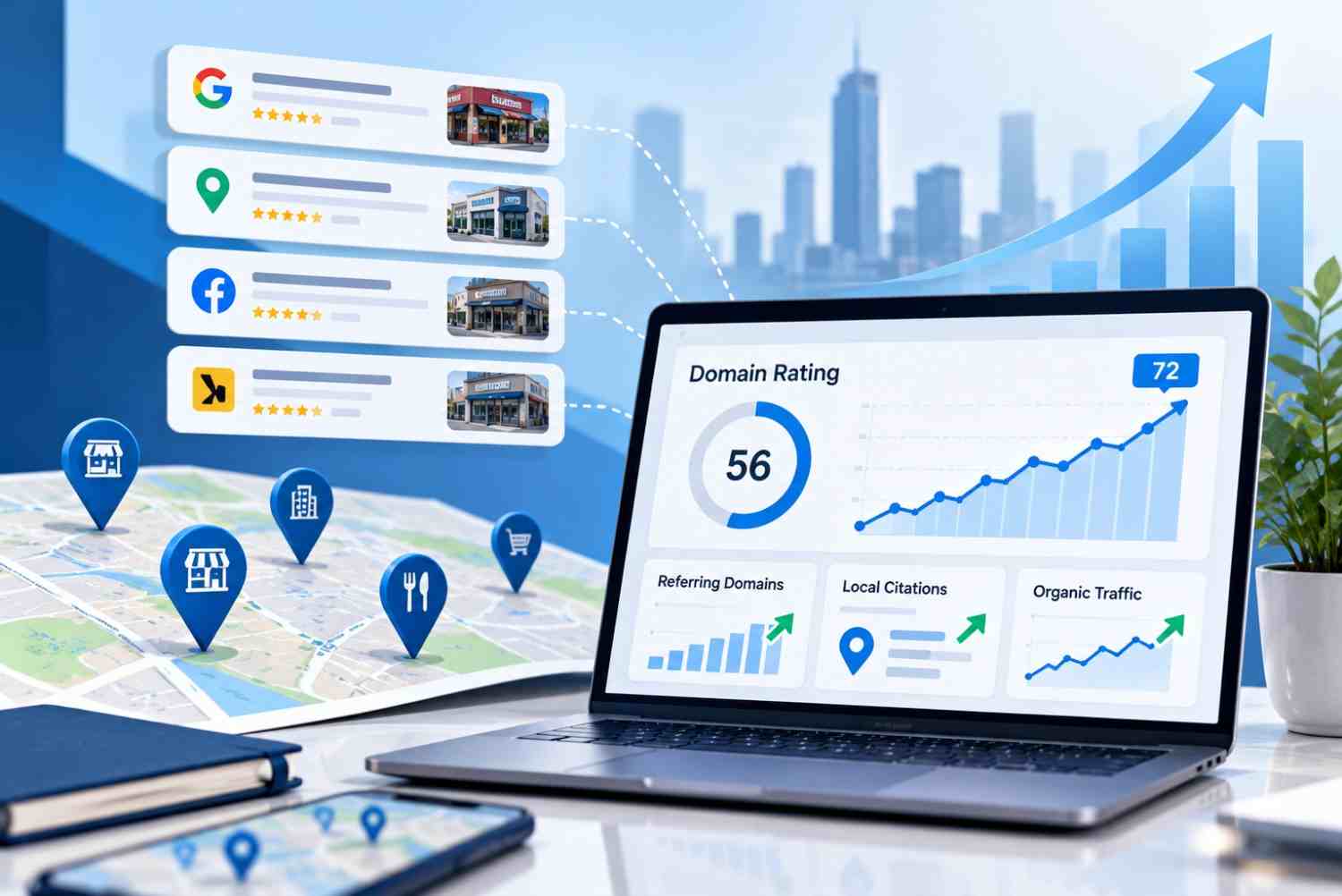
Every digital agency owner knows the quiet frustration of watching authority metrics stay frozen. You publish helpful articles, clean up technical errors, and wait for weeks. Yet your dashboard numbers barely move, leaving clients doubtful and leadership teams nervous.
Many business owners wonder whether directory submissions solve this growth puzzle. Learning how to increase domain rating Ahrefs helps technical marketers build stable backlink profiles without risking algorithmic penalties. A smart approach helps teams avoid empty link promises.
Recent search industry analysis reveals that 68% of local business websites remain stuck below DR 15 despite regular content production. Most directory listings don’t pass raw algorithmic PageRank. Grasping how citation data interacts with link-calculation engines saves months of wasted effort.
Third-party crawlers evaluate your website differently than search engine neural networks do. Google evaluates entity consistency, phone records, and physical street addresses to rank map listings. In contrast, crawler scores focus strictly on link topology.
Understanding how citations influence authority metrics requires separating search visibility from commercial software scores. Third-party indexes count followed hyperlinks between unique root domains. Unlinked name, address, and phone mentions confirm business legitimacy, yet they contribute zero direct weight to crawler calculations.
This structural divide confuses many marketing teams during quarterly reporting meetings. When an agency submits profiles to hundreds of low-tier aggregator platforms, nothing changes inside third-party monitors. Investing in clean, high-authority business profiles bridges this gap by delivering verified links and real local presence.
Choosing the right mix of incoming references requires clear visibility into how links behave. The comparative table below outlines the core differences across major link categories.
| Evaluation Metric | High-Tier Local Citations | Nofollow Business Directories | Contextual Editorial Backlinks |
| Direct Impact On DR | Moderate initial gains for fresh domains | Zero direct movement on metric scores | High compounding growth across all tiers |
| Link Attribute State | Dofollow profile links or homepage fields | Rel=”nofollow”, “ugc”, or plain text | Natural contextual in-content dofollow |
| Search Engine Entity Trust | High geographic relevance and NAP proof | High local verification and phone proof | High topical authority and semantic proof |
| Acquisition Investment | Predictable, low cost, rapid deployment | Low cost, automated directory sync | High cost, extensive manual outreach |
Ahrefs computes Domain Rating on a logarithmic scale from 0 to 100. Moving a brand new website from DR 0 to DR 20 takes relatively few referring domains. Pushing an enterprise site from DR 70 to DR 80 requires thousands of distinct authoritative references.
High-authority business registries often provide dofollow links from root domains holding scores above DR 80. When a new brand lands ten to twenty of these links, the metric jumps quickly. This early foundation proves helpful when measuring website trust and authority across emerging web assets.
However, diminishing returns appear rapidly once a site establishes baseline visibility. Because the calculation splits equity across every external site a directory links to, individual citation link equity remains diluted. Citations supply the baseline foundation, but contextual industry links must drive higher-tier metric scaling.
A regional commercial roofing specialist in Phoenix launched a redesigned web portal on a brand-new domain. Two months after launch, their dashboard showed zero referring domains and a static DR 0. Potential corporate clients questioned the company’s online standing during competitive bidding reviews.
Citations Check implemented a manual submission campaign targeting fifty top-tier business directories and trade portals. We audited every listing to ensure indexable, dofollow profile links with identical location records. Within six weeks, search crawlers discovered twenty-two clean referring domains. The website climbed to DR 19, which helped their sales team win multiple enterprise construction contracts.
A multi-location pediatric dental practice in Ohio maintained twenty clinic locations but saw their metrics stagnate at DR 28. An automated directory tool had pushed thousands of low-grade scraped profiles across abandoned web properties. Many of these low-tier pages contained broken links, wrong phone numbers, and duplicate entries.
Our audit team removed over 400 toxic directory entries and updated their core 25 regional business profiles. We secured verified listings on recognized healthcare networks and community business portals. Cleaning these citations removed link index bloat and restored consistent citation flow. Their score rose to DR 35, while map rankings improved across all twenty branch locations.
Systematic execution protects your website from automated indexing traps. An orderly rollout helps your listings earn both crawler equity and local consumer trust.
Check your corporate name, physical address, and official telephone number across existing platforms. Remove duplicate profiles that confuse web crawlers and dilute brand signals.
Practitioner Insight: In our client campaigns, we find that even minor punctuation mismatches between suite numbers can cause indexation drops. Standardize your address formatting before submitting a single new profile.
Select vetted industry directories and local trade associations that grant followed links to your homepage. Prioritize portals that carry independent root authority scores above DR 70.
Practitioner Insight: Test directory submission forms manually before purchasing listing packages. Many directories quietly append nofollow tags to submission fields, preventing metric improvements.
Submitting your profile represents only the first half of the assignment. Track each live profile URL using web monitoring tools to confirm search engine crawlers find the page.
Practitioner Insight: Unindexed profile pages pass zero algorithmic authority to your target URL. Share live directory profile links across your active brand channels to encourage rapid crawler discovery.
Expand your link profile by earning editorial references in local news publications and industry blogs. Blending directory listings with editorial mentions creates a natural backlink pattern.
Practitioner Insight: Never rely solely on business directories once your site clears DR 25. Transition your primary budget toward digital PR campaigns while maintaining clean citation records.
Rushing into cheap link bundles often damages domain health. Low-cost automated networks create low-value profiles on link farms that search algorithms routinely ignore.
Clean profile data encourages organic click-through traffic from actual local buyers. Search crawlers reward pages that demonstrate real human interaction alongside clean code structures. Protecting your business identity across reliable web directories forms the cornerstone of lasting digital performance.
Do Nofollow Local Citations Increase Domain Rating?
No, nofollow directory links do not increase this specific third-party score. Third-party calculation formulas ignore nofollow, sponsored, and user-generated tags when generating domain-level scores. However, nofollow citations remain essential for building local pack visibility and authentic brand signals.
How Many Citations Does a New Website Need to Move the Needle?
A new website generally needs between twenty and forty high-quality citations with followed links to see early movement. These clean referring domains can lift an initial score from zero to fifteen within several months. Lower-tier platforms provide negligible benefits once you establish this basic foundation.
Why Did My Domain Rating Drop After Building New Citations?
A score drop usually occurs because other websites across the global index gained links faster than your site did. The metric is a relative scale, not an absolute assessment of website quality. A drop can also happen if third-party crawlers drop inactive directory pages from their index.
How Long Does It Take for New Citations to Show on Dashboards?
New citations usually appear on dashboard reports within four to eight weeks. The delay depends on how frequently third-party crawlers visit the specific directory pages where your profile lives. You can speed up discovery by sharing profile URLs across active social channels.
Can Inconsistent Citation Data Hurt My Organic Search Positions?
Yes, conflicting address and telephone records confuse search algorithms and harm local rankings. When crawlers discover mismatched location data across platforms, they lose confidence in your primary entity profile. Keeping your core contact details aligned protects local search traffic and builds lasting online credibility.
Building genuine online authority requires patience, accurate information, and steady execution. Chasing short-term score spikes through automated link schemes creates fragile profiles that collapse during algorithmic updates. Investing in verified business assets protects your brand equity over time.
Citations Check takes the stress out of managing online business listings. Our specialists manually build, audit, and clean local profiles across the web’s most trusted business registries. If you want to increase your Ahrefs domain rating safely, our strategic data framework delivers reliable results.
Take control of your digital visibility today. Connect with our data team to audit your current directory profile and build an authority plan that drives verified business growth.